Page Titles & Search Descriptions
Having unique title tags and meta descriptions for every page is important for Search Engine Optimisation. The title tag and the meta description tags should include keywords relevant to the content of the web page they describe. This helps Search Engines understand what the page is about and index your web pages accordingly for relevant keywords or keyword phrases. You can improve your page titles and search descriptions by using the CCH Web Manager content management system.
Page Title (Title Meta Tag)
What is a page title?
The meta title is a title you give your webpage within the meta tags, so that when a person sees a link to your page from the search engine, it has a title to go with it. It is also visible at the top of the page tab in many web browsers and is saved as the title of a bookmark if a user saves it.
When we build a new website, we include a default title structure which usually consists of your company name, some key words, location and country. You can improve these by going through each page in your site tree and adding the page name or heading from the page. For example, on your firm profile page, your title could be:
Page Name, Company Name, Location
Page Name | Company Name | Location
So, an example for a fake company - Smith & Jones:
Firm Profile | Smith & Jones | Suburb, Region
Note: You generally don’t need to add your country as a meta tag because modern search engines (like Google) don’t rely on a “country” meta tag for location targeting.
Here are a few tips for creating titles for web pages:
- Keep your title brief and descriptive that is relevant to the content of your pages.
- Avoid keyword stuffing, i.e. repeating the same words or phrases multiple times.
- Avoid repeated titles. Create unique titles for each page of your site.
Note that the recommended maximum number of characters (including spaces and symbols) is 65, you can add more, but they may get ignored.
Page Description (Description Meta Tag)
What is a page description?
The meta description is a 160-character snippet, a tag in HTML, that summarises a page's content. Search engines show the meta description in search results mostly when the searched-for phrase is contained in the description.
When we build a new website, we include a description in your home category/page of your site, and we often take part of your home page text for this. You can improve your website by going through each category/page in your site tree and adding a brief description of what the page is about while trying to add keywords and phrases into the description.
Here are a few tips for creating meta descriptions for the web pages:
- Make sure that every page of your site has a meta description.
- Create concise and high-quality descriptions that accurately describe your page.
- Try to use words and phrases that users are likely to type into the search field.
- Make sure each page on your website has a different meta description.
The suggested maximum length of the meta description is between 150 to 160 characters, including spaces.
Note: You generally don’t need to add your country as a meta tag because modern search engines (like Google) don’t rely on a “country” meta tag for location targeting.
Editing Page Titles and Page Descriptions
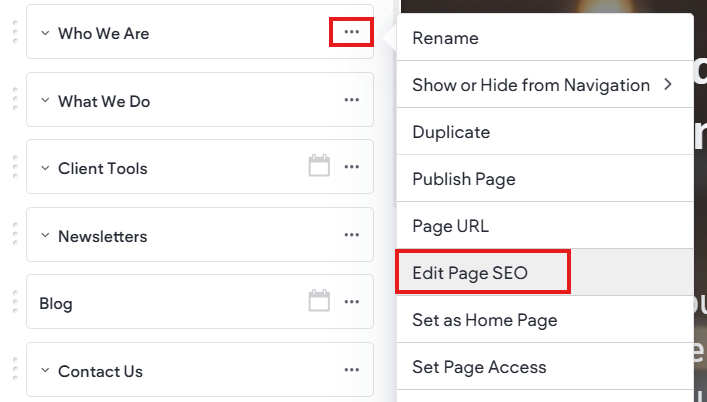
Select the Pages option from the main menu on the left-hand side and click the three dots on the page you wish to edit the title or description for, and select Edit Page SEO.
Edit the content in either the Page Title or Page Description fields.

Note: If you would like a page to be blocked from search engines check the Set page to no index option.
NOTE: If you want to review and edit your SEO Page Titles and Descriptions in all one view, you can either click SEO/AEO from the left menu OR click the three-line icon at the top right and select Site Dashboard. Once on the Dashboard, select Performance > Page SEO. Please see: Page SEO